From 22 unfocused accounts to $1.8M in year-one growth
From 22 unfocused accounts to $1.8M in year-one growth
From 22 unfocused accounts to $1.8M in year-one growth
Portfolio Growth Program
$8m
annual revenue across client portfolio
$1.8m
Year 1 expanded consulting revenue
$3.6m
Qualified pipeline expansion discussions

The opportunity was real. The focus wasn’t
A B2B technology consulting company had strong clients, deep technical credibility, and clear expansion potential across implementation, integration, optimization, and managed services. But growth was inconsistent because too many accounts looked promising on the surface.
The issue wasn’t a lack of possible opportunities. It was the quality of those opportunities. Some accounts had relationships without urgency, technical needs without a budget path, and champions without authority. Others showed stronger commercial signals but weren’t getting enough focus.
What the Portfolio Growth Program exposed
Kevin assessed 22 active client accounts with leadership, sales, account management, and delivery. The review tested each account against commercial signals, stakeholder dynamics, budget logic, and expected revenue. Three issues surfaced.
The company was treating technical needs as growth potential. Even when there was no business owner, budget path, decision window, or executive pressure.
Account plans were too delivery-led. Focused on what the team could implement rather than the business problems the client needed to solve.
Leadership attention was going to active accounts rather than valuable ones. Accounts with positive client sentiment were getting disproportionate attention, while stronger opportunities were under-supported.
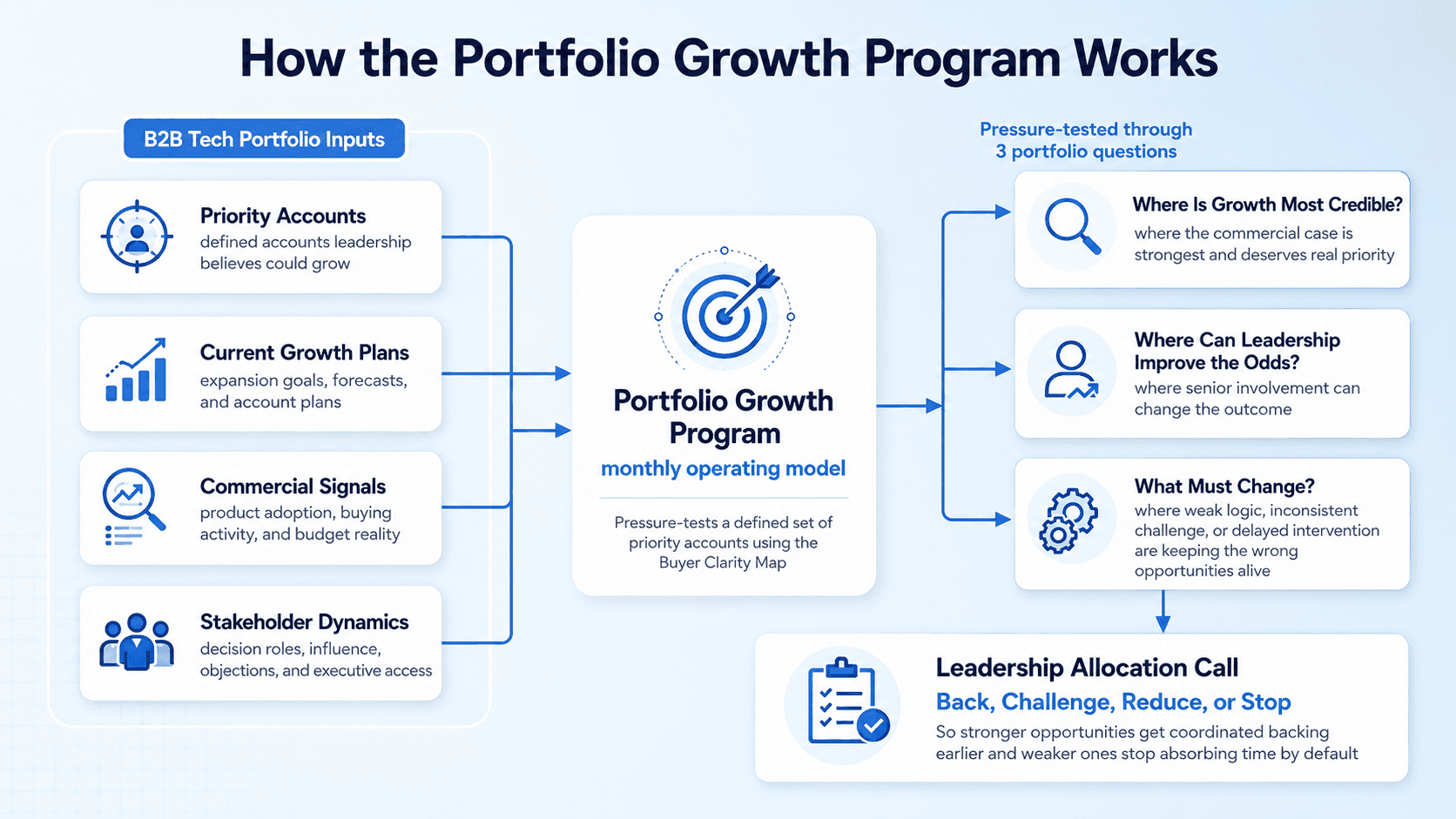
What changed
The company stopped asking, “Where could we sell more?” and started asking, “Where is growth most credible?” Accounts with warm relationships but weak budget logic were moved out of active pursuit. Accounts with stronger adoption risk, executive pressure, and clearer business impact were prioritized. The team shifted from pitching more implementation support to building business cases around adoption, workflow efficiency, reporting visibility, and reduced operational drag. That created stronger executive conversations and a clearer path to funded work.
The result
Before the Portfolio Growth Program, the company had 22 accounts in active growth discussions but no reliable way to decide which deserved priority. Within one portfolio cycle, leadership narrowed its focus to six priority accounts. Weaker opportunities were challenged, reshaped, or removed from active pursuit. Senior time was redirected toward accounts where involvement could materially improve the odds.
In year one, the company generated $1.8M in new and expanded consulting revenue and built $3.6M in qualified expansion pipeline from the priority account group. The biggest change was not more activity. It was better commercial judgment.
The opportunity was real. The focus wasn’t
A B2B technology consulting company had strong clients, deep technical credibility, and clear expansion potential across implementation, integration, optimization, and managed services. But growth was inconsistent because too many accounts looked promising on the surface.
The issue wasn’t a lack of possible opportunities. It was the quality of those opportunities. Some accounts had relationships without urgency, technical needs without a budget path, and champions without authority. Others showed stronger commercial signals but weren’t getting enough focus.
What the Portfolio Growth Program exposed
Kevin assessed 22 active client accounts with leadership, sales, account management, and delivery. The review tested each account against commercial signals, stakeholder dynamics, budget logic, and expected revenue. Three issues surfaced.
The company was treating technical needs as growth potential. Even when there was no business owner, budget path, decision window, or executive pressure.
Account plans were too delivery-led. Focused on what the team could implement rather than the business problems the client needed to solve.
Leadership attention was going to active accounts rather than valuable ones. Accounts with positive client sentiment were getting disproportionate attention, while stronger opportunities were under-supported.
What changed
The company stopped asking, “Where could we sell more?” and started asking, “Where is growth most credible?” Accounts with warm relationships but weak budget logic were moved out of active pursuit. Accounts with stronger adoption risk, executive pressure, and clearer business impact were prioritized. The team shifted from pitching more implementation support to building business cases around adoption, workflow efficiency, reporting visibility, and reduced operational drag. That created stronger executive conversations and a clearer path to funded work.
The result
Before the Portfolio Growth Program, the company had 22 accounts in active growth discussions but no reliable way to decide which deserved priority. Within one portfolio cycle, leadership narrowed its focus to six priority accounts. Weaker opportunities were challenged, reshaped, or removed from active pursuit. Senior time was redirected toward accounts where involvement could materially improve the odds.
In year one, the company generated $1.8M in new and expanded consulting revenue and built $3.6M in qualified expansion pipeline from the priority account group. The biggest change was not more activity. It was better commercial judgment.
"Kevin helped us see that we weren’t managing a growth portfolio. We were managing a long list of hopeful accounts. The Portfolio Growth Program gave us a way to challenge our assumptions, focus leadership attention, and stop treating every possible opportunity like it deserved the same effort."

CEO
B2B Technology Consulting Company
"Kevin helped us see that we weren’t managing a growth portfolio. We were managing a long list of hopeful accounts. The Portfolio Growth Program gave us a way to challenge our assumptions, focus leadership attention, and stop treating every possible opportunity like it deserved the same effort."
CEO
B2B Technology Consulting Company

