

The Map and the Terrain
Every company has a map. It’s called the ICP. It’s clean, logical, and framed as alignment. Industry. Size. Title. Budget. But when the quarter closes, the map rarely matches the terrain.
The accounts that looked perfect don’t move. The ones that weren’t even on the list become the biggest opportunities. That’s because the map is static and the terrain moves.
The classic ICP described the world as it was. But growth happens in the world as it is. The Buyer Clarity Map begins exactly there, at the intersection of fit and movement. It replaces guesswork with context: the evidence of when, why, and how buyers actually decide.
The Hidden Cost of Static ICPs
Static ICPs were built for predictability, not reality. They fail because they describe customers, not conditions.
They describe the past. Most ICPs are based on who bought yesterday, not who’s ready today.
They ignore context. Fit alone doesn’t create movement. Urgency does. A “good-fit” account without a trigger is noise; a “non-fit” account under pressure is signal.
They stop at marketing. Without shared ownership, the ICP becomes a wall chart. Sales stretches it. Marketing narrows it. CS inherits the consequences.
That’s why the first checkpoint of the Buyer Clarity Map focuses on Buyer Context and Triggers, the moment you move from describing potential to detecting motion.
From Description to Direction
The modern ICP isn’t a profile. It’s a system of motion. The Buyer Clarity Map reframes it through three essential questions:
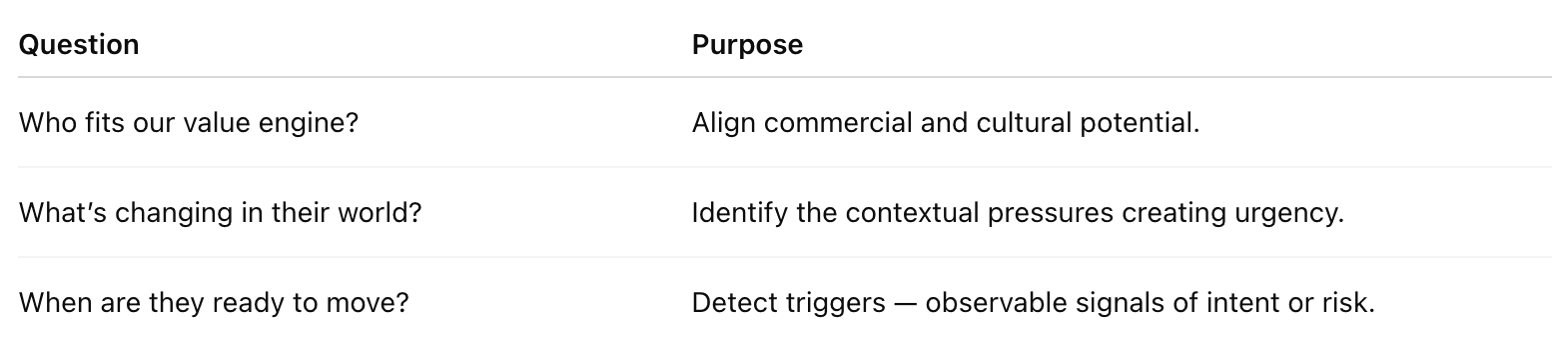
These questions aren’t abstract. They form the foundation of Checkpoint 1 in the BCM, a clarity discipline that operationalizes understanding. They anchor every forecast, campaign, and conversation in buyer reality, not departmental preference.
Why Context Wins
Executives don’t buy based on logic alone. They buy based on timing, tension, and proof. The static ICP points to potential. The context-based ICP points to readiness. That’s the pivot. From fit to readiness. From segments to signals. From description to decision velocity.
When context drives your system, every department sharpens:
Marketing stops shouting.
Sales stops guessing.
Leadership stops debating who matters most.
This is where the BCM starts to compound, when every team sees what the buyer sees, together.
The Science Beneath It
B2B buying isn’t purely rational; it’s behavioural. Executives weigh risk more than opportunity. They manage perception as much as performance.
The Buyer Clarity Map encodes those truths into ICP design. It forces teams to account for Loss Aversion (fear of failure), Status Quo Bias (safety in inaction), and Social Proof (confidence through peers).
By tracking triggers that correspond to these biases, missed targets, leadership changes, and peer adoption, the ICP moves from describing buyers to predicting behaviour.
Static vs. Dynamic ICPs
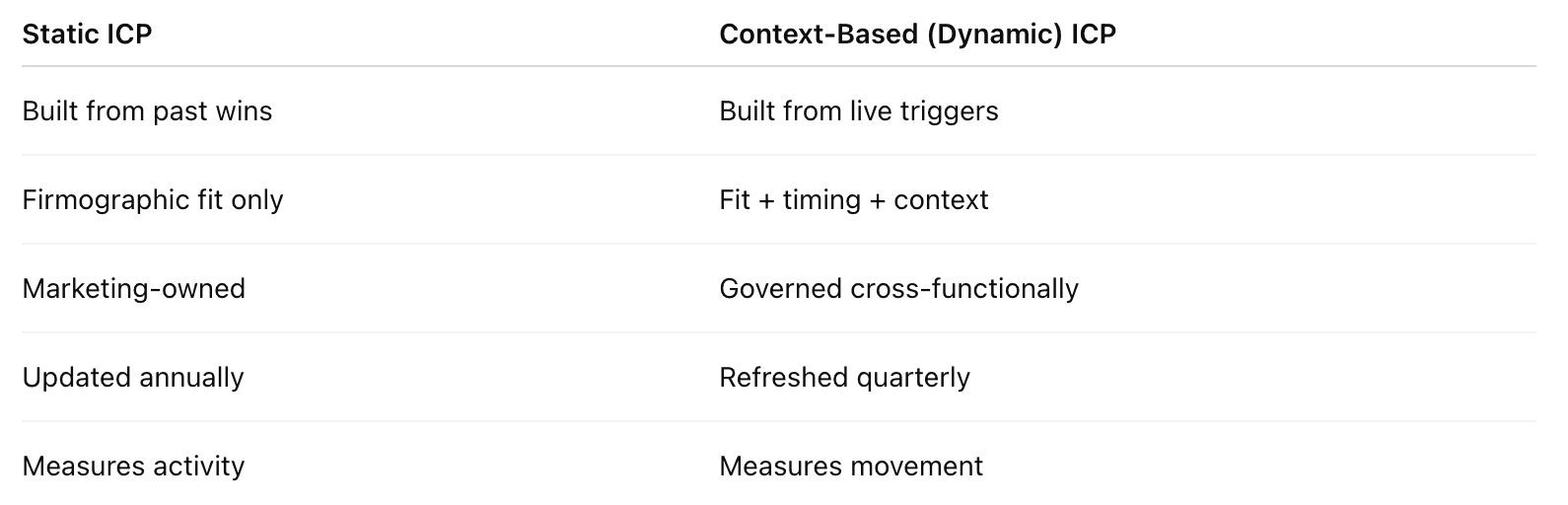
This is the first evolution of the Buyer Clarity Map from a static view to a living system. When context becomes your compass, clarity becomes your advantage.
Leadership Actions: Turning Definition into Discipline
Defining an ICP is easy. Running it as a system is leadership work. Here’s how to keep your ICP in motion, anchored in buyer context, not internal comfort.
1. Audit for Motion
Ask: Does your ICP reflect who moved, or who could move? Static ICPs measure fit. Operational ones measure readiness.
Review recent deals and tag shared triggers (leadership changes, missed targets, etc.).
Compare those triggers to your ICP attributes; gaps reveal clarity decay.
BCM Insight: This is Checkpoint 1 – Buyer Context & Triggers: replacing description with detection.
2. Add Triggers to Every Definition
Ask: What changes in their world create urgency and how do they describe it?
For each segment, define three observable triggers and capture the buyer’s language.
Embed both in CRM fields, playbooks, and campaign briefs.
BCM Insight: Turns ICP into telemetry, not taxonomy.
3. Refresh Quarterly
Ask: Are we running on current context or expired assumptions?
Make ICP refresh a standing quarterly exec review item.
Update triggers and language using fresh buyer data.
BCM Insight: Core to the BCM’s governance cadence, clarity reviewed like forecasts.
4. Align Cross-Functionally
Ask: Do all functions define “ideal” the same way?
Create one shared ICP doc owned by CMO + CRO + CS.
Review alignment in pipeline meetings, not marketing offsites.
BCM Insight: Builds Checkpoint 5 – Narrative Resonance internally first.
5. Measure Clarity
Ask: Are we tracking movement or just marketing?
Add clarity metrics: Drift Score, Trigger Velocity, Win Rate by Trigger.
Reward accuracy and learning speed over volume.
BCM Insight: Clarity becomes capital when it’s measured.
The Payoff
When clarity moves, everything else compounds. Teams stop chasing noise and start detecting momentum. Forecasts stop wobbling because “ideal” finally means ready. And leadership stops managing opinion and starts managing evidence.
This is the shift, from marketing alignment to organizational precision. From chasing demand to predicting movement. From brand awareness to buyer awareness.
The companies that master this aren’t just seeing the market, they’re shaping it in real time.
Audit your ICP. Add triggers. Refresh quarterly. Because the firms that operationalize clarity don’t just grow faster, they make growth predictable.
That’s the promise behind the Buyer Clarity Map, turning definition into discipline, and motion into momentum.