Blog
Stop Marketing to Ghosts: You're Missing 95% of B2B Buyers
Stop Marketing to Ghosts: You're Missing 95% of B2B Buyers
Stop Marketing to Ghosts: You're Missing 95% of B2B Buyers
Marketing

Your marketing budget: where's it really going? If you're like most B2B leaders, you're pouring cash into campaigns, seeing MQLs dwindle, pipelines stagnate, and your team constantly chasing buyers who seem to have already decided. Here's the blunt truth: only 5% of your potential market is actively buying right now. The other 95%? They're out-of-market, and your current strategy is likely ignoring them.
This isn't "demand generation." It's "demand dependency." You're just reacting, scrambling for a tiny fraction of buyers showing immediate interest. Meanwhile, the vast majority, who will eventually buy, are left cold. This blind spot hits hard: inflated Customer Acquisition Costs (CAC), razor-thin margins from endless bidding wars, painfully long sales cycles, and a constant fight for market share.
The 95:5 Rule: It's About Being Available, Not Just Known
Professor John Dawes' 95:5 rule tells us something crucial about how humans buy. Buyers aren't robots. Their brains build "mental shortcuts" brand memories that just sit there until a Category Entry Point (CEP) sparks them. Your goal isn't just for them to know you. It's for them to choose you the instant a problem or opportunity arises. You want to be their automatic first thought.
This "availability" strategy shatters the common "product delusion" in B2B. That myth says buyers meticulously research and always pick the "best" product. Nope. Most just "satisfice," choosing the brand that's easiest to recall and feels like a safe bet. Your job isn't to prove "best," it's to lock in "first-in-mind."
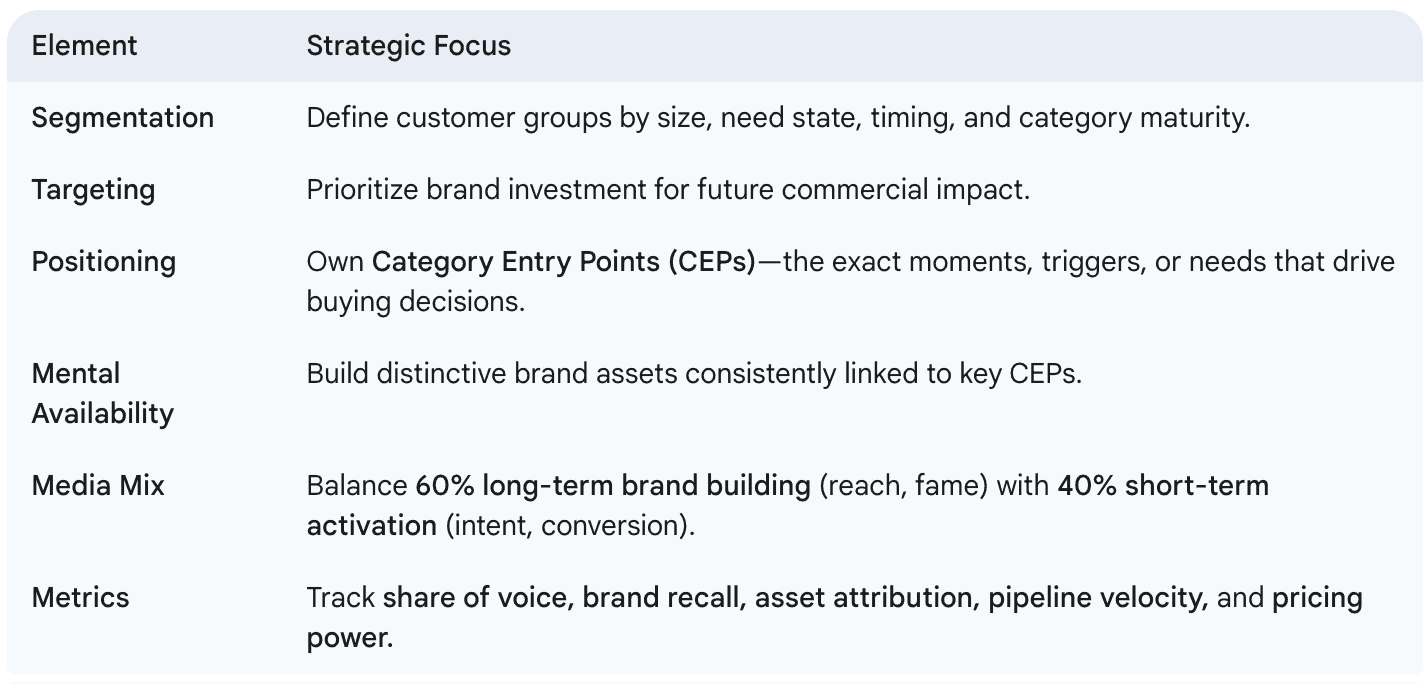
This doesn't mean mass-marketing to everyone. It demands sharp segmentation, targeting, and positioning. Build memory structures in the right segments, tied to the right buying triggers, before they ever hit your funnel.
Your 95:5 Planning Canvas: Build a Buying Reflex
Shift from reactive capture to proactive generation. Use the 95:5 Planning Canvas as your guide:
Intent Data: It's Your Rearview Mirror, Not Your Headlights
We've oversold intent data. When a buyer finally shows "intent," they've often already narrowed their choices. Intent data is a rearview mirror; it tells you where they've been. Brand memory is your headlights; it ensures you're visible before they even start looking. If you're not building that memory, you're not grabbing demand; you're just bidding for leftovers.
Mental availability means being easily recalled. It’s about forging strong neural pathways. Every consistent touchpoint, every unique brand asset tied to a CEP, reinforces those paths. Think of project management SaaS: CEPs aren’t just "need PM software"; they’re "our team keeps missing deadlines," or "onboarding new hires is a mess." Your brand must own the solution to these specific pains long before an RFP even gets drafted.
Here’s the kicker: for building mental availability, emotion beats pure logic. B2B buyers use logic for the final decision, sure, but their brains remember emotions and stories. Your brand's assets and narratives should aim to evoke feelings of confidence, relief, and ambition because strong emotions create stronger, more accessible memories. And forget targeting just a few; reach all potential buyers broadly, consistently. "Test and learn" often means inconsistent, short-lived campaigns that fail. Think "always-on," not "campaign bursts."
Metrics That Matter: More Than MQLs & CPLs
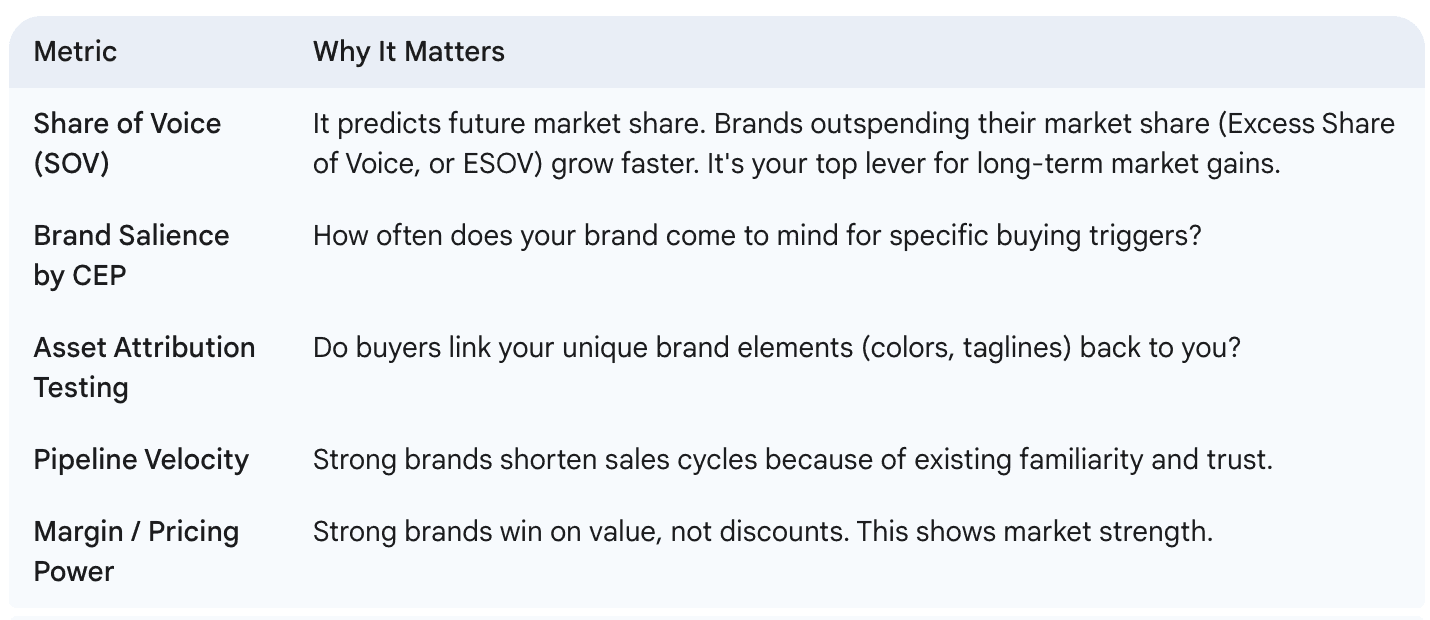
If your dashboard is stuck on MQLs and CPLs, you're optimizing symptoms, not real growth. These metrics work for immediate activation, showing efficiency within that 5% actively buying. But they're not enough for long-term growth. They tell you who's ready now, but not who'll be ready next, or why they picked you.
Actionable Shift: Quick Wins & Long Plays
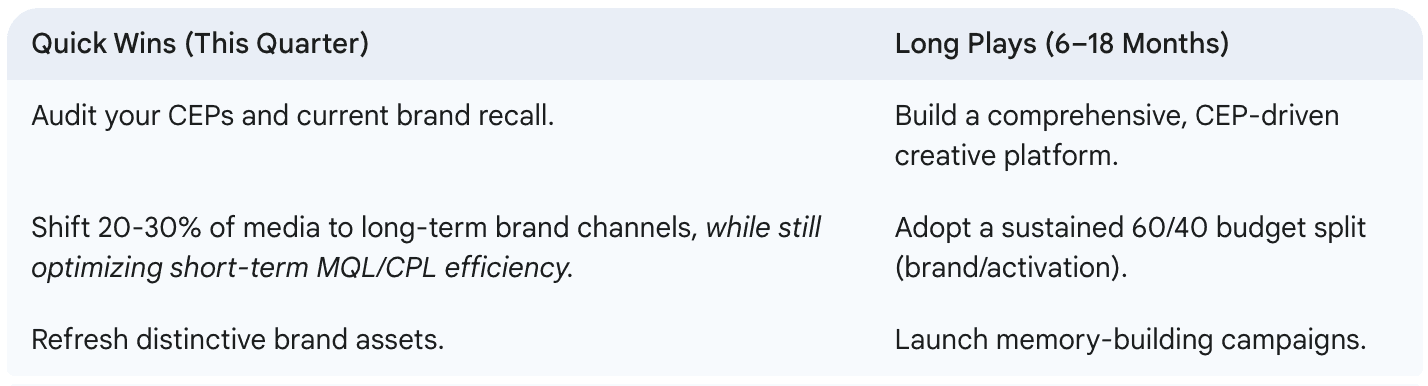
Shifting your strategy means tackling internal resistance. You'll need to convince stakeholders to invest beyond short-term "performance" metrics. Show them that brand investment is future pipeline and profitability.
Boardroom Imperatives
Changing your marketing strategy means changing how leadership sees growth. These short, powerful statements are your ammunition for those critical boardroom discussions, framing the 95:5 rule in terms of undeniable business impact:
"Stop renting demand. Start owning memory."
"You don't get shortlisted. You get remembered—or you don't."
"If your pipeline only works on the 5%, you're invisible to the 95% who matter next."
"Brand isn't soft. It's future cash flow."
"Intent is rearview marketing. Brand is headlights."
"MQLs measure who's knocking on your door today. Brand builds the house everyone wants to enter tomorrow."
Choose Your Game: Performance or Permanence?
Most B2B marketing just captures existing demand. But the best marketers, the ones building category leaders, play a longer game: they build brands around real buying triggers, plant memory in the 95% before the funnel even starts, and train the market to expect, remember, and prefer them.
You don't win mindshare when the RFP drops. You win it years before it's even written.
So, what's your play? Will you keep optimizing just for immediate performance (MQLs, CPLs) within that fleeting 5%? Or will you strategically invest in permanence, cultivating deep mental availability within the vast 95%, building a brand that not only captures demand efficiently but creates it, shortens sales cycles, and commands premium value for years?
The time to stop marketing to ghosts and start building enduring memory is now.
Your marketing budget: where's it really going? If you're like most B2B leaders, you're pouring cash into campaigns, seeing MQLs dwindle, pipelines stagnate, and your team constantly chasing buyers who seem to have already decided. Here's the blunt truth: only 5% of your potential market is actively buying right now. The other 95%? They're out-of-market, and your current strategy is likely ignoring them.
This isn't "demand generation." It's "demand dependency." You're just reacting, scrambling for a tiny fraction of buyers showing immediate interest. Meanwhile, the vast majority, who will eventually buy, are left cold. This blind spot hits hard: inflated Customer Acquisition Costs (CAC), razor-thin margins from endless bidding wars, painfully long sales cycles, and a constant fight for market share.
The 95:5 Rule: It's About Being Available, Not Just Known
Professor John Dawes' 95:5 rule tells us something crucial about how humans buy. Buyers aren't robots. Their brains build "mental shortcuts" brand memories that just sit there until a Category Entry Point (CEP) sparks them. Your goal isn't just for them to know you. It's for them to choose you the instant a problem or opportunity arises. You want to be their automatic first thought.
This "availability" strategy shatters the common "product delusion" in B2B. That myth says buyers meticulously research and always pick the "best" product. Nope. Most just "satisfice," choosing the brand that's easiest to recall and feels like a safe bet. Your job isn't to prove "best," it's to lock in "first-in-mind."
This doesn't mean mass-marketing to everyone. It demands sharp segmentation, targeting, and positioning. Build memory structures in the right segments, tied to the right buying triggers, before they ever hit your funnel.
Your 95:5 Planning Canvas: Build a Buying Reflex
Shift from reactive capture to proactive generation. Use the 95:5 Planning Canvas as your guide:
Intent Data: It's Your Rearview Mirror, Not Your Headlights
We've oversold intent data. When a buyer finally shows "intent," they've often already narrowed their choices. Intent data is a rearview mirror; it tells you where they've been. Brand memory is your headlights; it ensures you're visible before they even start looking. If you're not building that memory, you're not grabbing demand; you're just bidding for leftovers.
Mental availability means being easily recalled. It’s about forging strong neural pathways. Every consistent touchpoint, every unique brand asset tied to a CEP, reinforces those paths. Think of project management SaaS: CEPs aren’t just "need PM software"; they’re "our team keeps missing deadlines," or "onboarding new hires is a mess." Your brand must own the solution to these specific pains long before an RFP even gets drafted.
Here’s the kicker: for building mental availability, emotion beats pure logic. B2B buyers use logic for the final decision, sure, but their brains remember emotions and stories. Your brand's assets and narratives should aim to evoke feelings of confidence, relief, and ambition because strong emotions create stronger, more accessible memories. And forget targeting just a few; reach all potential buyers broadly, consistently. "Test and learn" often means inconsistent, short-lived campaigns that fail. Think "always-on," not "campaign bursts."
Metrics That Matter: More Than MQLs & CPLs
If your dashboard is stuck on MQLs and CPLs, you're optimizing symptoms, not real growth. These metrics work for immediate activation, showing efficiency within that 5% actively buying. But they're not enough for long-term growth. They tell you who's ready now, but not who'll be ready next, or why they picked you.
Actionable Shift: Quick Wins & Long Plays
Shifting your strategy means tackling internal resistance. You'll need to convince stakeholders to invest beyond short-term "performance" metrics. Show them that brand investment is future pipeline and profitability.
Boardroom Imperatives
Changing your marketing strategy means changing how leadership sees growth. These short, powerful statements are your ammunition for those critical boardroom discussions, framing the 95:5 rule in terms of undeniable business impact:
"Stop renting demand. Start owning memory."
"You don't get shortlisted. You get remembered—or you don't."
"If your pipeline only works on the 5%, you're invisible to the 95% who matter next."
"Brand isn't soft. It's future cash flow."
"Intent is rearview marketing. Brand is headlights."
"MQLs measure who's knocking on your door today. Brand builds the house everyone wants to enter tomorrow."
Choose Your Game: Performance or Permanence?
Most B2B marketing just captures existing demand. But the best marketers, the ones building category leaders, play a longer game: they build brands around real buying triggers, plant memory in the 95% before the funnel even starts, and train the market to expect, remember, and prefer them.
You don't win mindshare when the RFP drops. You win it years before it's even written.
So, what's your play? Will you keep optimizing just for immediate performance (MQLs, CPLs) within that fleeting 5%? Or will you strategically invest in permanence, cultivating deep mental availability within the vast 95%, building a brand that not only captures demand efficiently but creates it, shortens sales cycles, and commands premium value for years?
The time to stop marketing to ghosts and start building enduring memory is now.
Get the Latest
Get the Latest
Be the first to discover insider tips, cultural itineraries, and the hidden gems of your favorite destinations.


